
A BRUGG GROUP COMPANY
The gas tightness of our FLEXSTAR heat pump pipe system FLEXSTAR was successfully verified as part of an independent system test by iro GmbH Oldenburg. The test was carried out based on the FHRK testing specification GE 101 in accordance with quality level D01. The gas tightness against positive internal air pressure was tested and confirmed.
The certification covers the following tested designs:
FLEXSTAR DUO 32+32/105 pipe system with EPDM end cap in combination with cable end sleeves on the FLEXSTAR outer casing and on the carrier pipes
FLEXSTAR DUO 32+32/105 pipe system with DHEC shrink end cap
Both variants were successfully tested as a system test in combination with the following accessories:
Curaflex C40/M/S gasket insert
DOYMAfix KEM cable end sleeves for the conduits
The tests were implemented with the following criteria in accordance with quality level D01:
Test medium: Air / Nitrogen
Test pressure according to FHRK D01
Permissible leakage rate: < 1 dm³/h
No pressure drop during the test period
Gas tightness against positive internal air pressure verified
The tests confirmed that the permissible leakage rate was not exceeded and that no pressure loss occurred. The system therefore fully meets the requirements of the FHRK testing specification GE 101.
The certification applies exclusively to the tested system configuration. It is only valid if the FLEXSTAR pipe system is used in a heat pump application in combination with the components listed above and the defined accessories. For this application, we also offer specially tailored heat pump sets that cover precisely this certified system configuration.
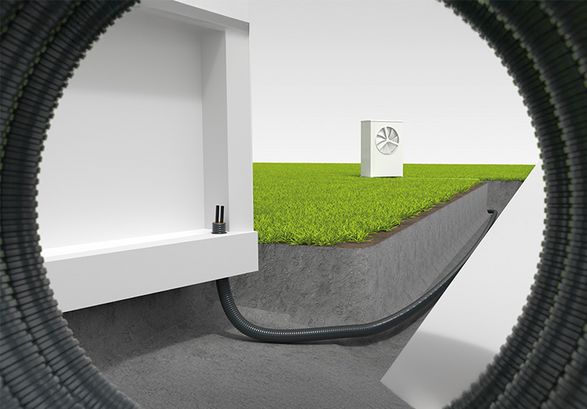
In connection with heat pumps, gas tightness means the secure sealing of the pipe penetration through the basement wall or floor slab. The aim is to prevent refrigerants from entering the building via the pipelines or their penetrations in the event of heat pump damage.
Particularly in modern, energy-efficient and airtight buildings, uncontrolled gas flows can have a greater impact because natural air exchange is lower. A professionally executed and tested gas-tight building entry therefore makes an important contribution to protecting buildings and people.
In practice, a refrigerant only becomes an acute explosion risk if several conditions are met simultaneously:
Outdoors, escaping refrigerant usually dissipates quickly.
In closed indoor spaces, however, the risk is significantly higher.
Relevant flammable refrigerants in heat pumps
Some refrigerants used in heat pumps are flammable and must therefore be taken into account in the safety assessment.
A3 = highly flammable
A2L = mildly flammable
In the present context, gas-tight means that the building entry or the pipe system is designed in such a way that no refrigerant can penetrate into the pipe system or into the building in a relevant quantity – neither in a gaseous nor in a liquid state.
Specifically, this includes the following requirements:
In the case of our FLEXSTAR system solution in a set with screw connections, EPDM end caps, gasket insert, hose clamps and cable end sleeves, this gas tightness was tested and confirmed as part of a complete system test by iro GmbH Oldenburg. The verification was carried out according to FHRK GE 101 in quality level D01.
The following image shows FLEXSTAR with the set components in a standard-compliant, gas-tight installation.
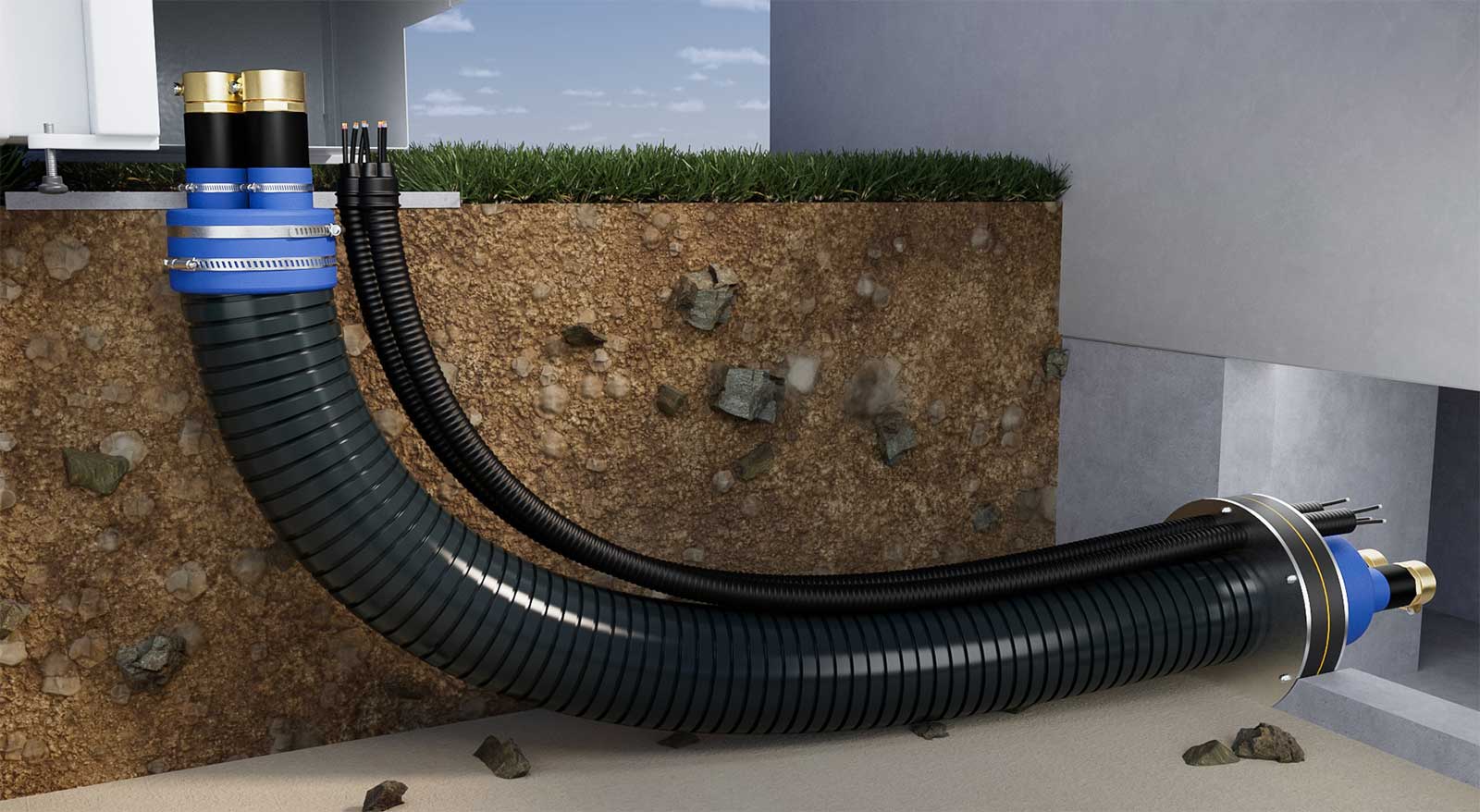
A tested, systemically verified gas-tight building entry for heat pump pipes
For planners, installers and building owners, this means:
Gas tightness in heat pump connections is not just a technical quality, but a relevant component of a risk-conscious and verifiable execution.
Minimisation of refrigerant
entry paths into the building
Reduces the risk of refrigerant entering interior spaces via the penetration and accumulating there in the event of a leak.
Increased safety with flammable refrigerants (e.g. R290)
Gas-tight design supports risk minimisation regarding ignitable atmospheres in closed rooms.
Preservation of building envelope
tightness as a side effect
Stabilises airtightness at critical penetrations (air/moisture protection concept).
Avoidance of subsequent remediation and rectification costs
Fewer leakage paths and clearly defined system details reduce the risk of expensive rework.
Documented safety through tested system solution
Test and certificate proofs enable a traceable and verifiable execution.
The risk in the event of a damaged or leaking heat pump pipe is the escaping refrigerant. Depending on the operating condition, not only gaseous but also liquid refrigerant may be released. These refrigerants can theoretically migrate through the pre-insulated piping system from the heat pump into the building. The released refrigerant can then evaporate and accumulate, particularly in closed or lower-lying areas such as basements, technical rooms, or shafts.
Pure longitudinal watertightness according to EN 15632-2 is not sufficient in this regard. The reason is that refrigerants behave differently from water due to their physical properties. They may escape in liquid form, evaporate, and spread as a gas within the building. An additional gas-tight design of the building entry for the heat pump line is therefore safety-relevant.
The tightness against radon and other ground gases is generally ensured by the annular seal used. In the case of heat pumps, however, a different scenario is relevant: here, the focus is not on the ingress of ground gases, but on the possible leakage of refrigerant from the heat pump system.
In this context, “gas-tight” means that the building entry or piping system of the heat pump is designed in such a way that no refrigerant in relevant quantities can enter the piping system or the building—neither in gaseous nor in liquid form.
This specifically includes:
For system solutions such as FLEXSTAR from BRUGG Pipes, this gas tightness has been tested and confirmed as part of a complete system test by iro GmbH Oldenburg. The verification was carried out according to FHRK GE 101 in quality level D01.
There is no standalone “gas tightness law” for building entries. However, requirements arise indirectly from building codes and operator obligations related to refrigeration and heat pump systems (depending on the country).
Indirectly relevant are in particular:
In practice this means:
Penetrations through basement walls and floor slabs must be designed and executed in a way that ensures permanent sealing and minimizes unwanted substance ingress.
For heat pump and refrigeration systems with fluorinated refrigerants, the following apply (EU/DE):
These regulations require:
Violations may result in sanctions:
Then choose FLEXSTAR for
easy installation
simple handling and transport
proven solution
high-quality insulation that reduces the lambda value by a full 40 percent compared to conventional PE insulation
system solution instead of system chaos
tested and safe gas tightness
manufactured according to EN 15632-2 and quality-assured according to ISO 9001, ISO 45001 and ISO 14001
